


Texas Real Estate Market Trends 2024
Last Updated:
Texas Housing Market Update: Insights for Real Estate Investors
Outlook for the Texas Economy
Our most recent webinar was an informative session led by Catalyst Funding’s industry experts: CEO, Wade Comeaux and Director of Lending Jeff Johnson with our special guest, Jennifer McCormick, Single-family Sales Manager at Lifestyles Realty, Inc.
This article includes some of the best segments of the webinar, allowing you to get an overview of topics that interest you most. Watch the entire presentation here:
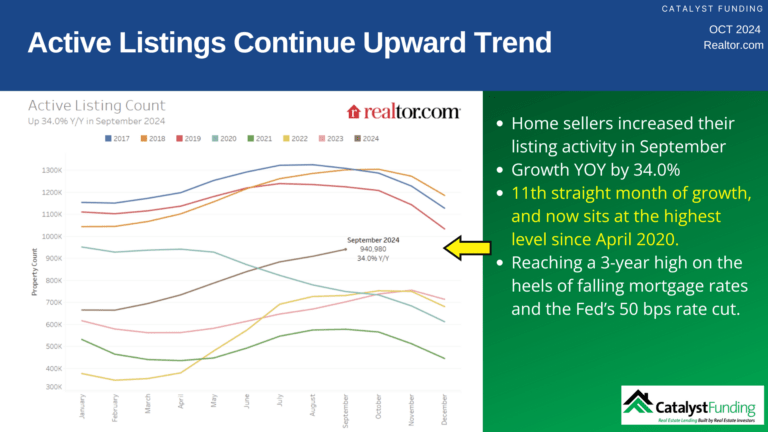
Active Listings Continue Upward Trend
A key highlight is the significant increase in active listings. There were 34% more homes for sale compared to the same time last year, marking the 11th consecutive month of annual inventory growth. This trend has brought the inventory to its highest level since early 2020, driven by a combination of lower mortgage rates and a recent 50 basis point cut by the Federal Reserve. For investors, this expanded inventory offers a broader selection of properties, making it an ideal moment for property loans or hard money loans to finance purchases.
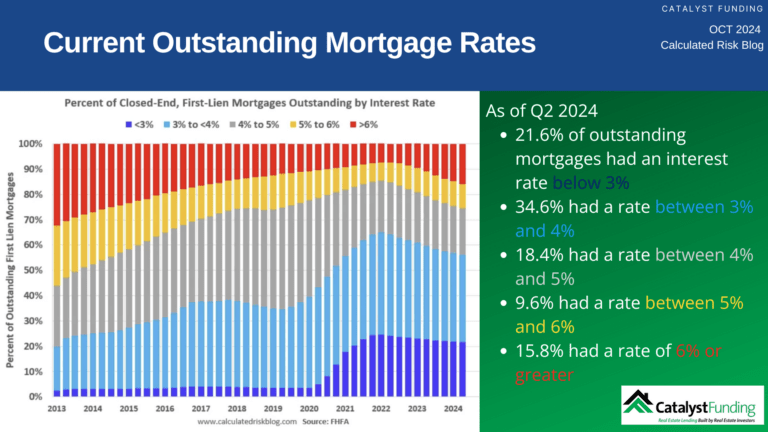
Current Outstanding Mortgage Rates
As of the second quarter of 2024, the landscape of outstanding mortgage rates shows that a significant portion of homeowners are benefiting from historically low rates. Specifically, 21.6% of outstanding mortgages have an interest rate below 3%, while 34.6% fall within the 3% to 4% range. Additionally, 18.4% have rates between 4% and 5%. A smaller segment of 9.6% holds rates between 5% and 6%, and 15.8% have rates of 6% or greater. This distribution suggests that many current homeowners may be reluctant to sell, potentially limiting supply. Investors should consider this dynamic when strategizing their acquisitions, as lower inventory could drive competition and prices higher.
“For savvy investors, understanding the implications of cash-out refinances and how they can help homeowners leverage their equity to make additional purchases is essential.”
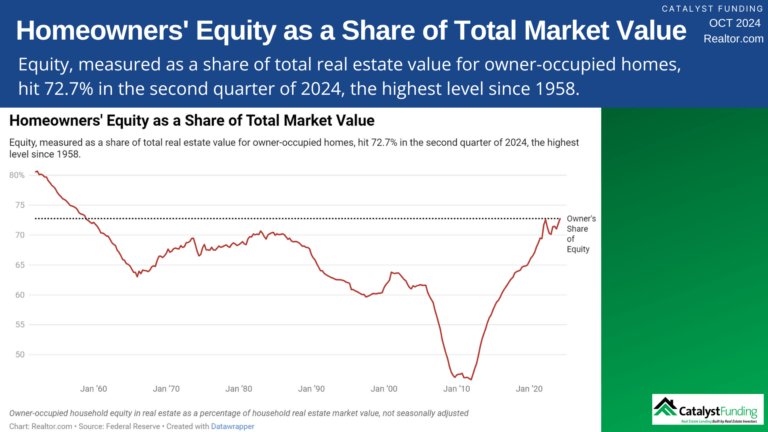
Homeowners' Equity at Historic Highs
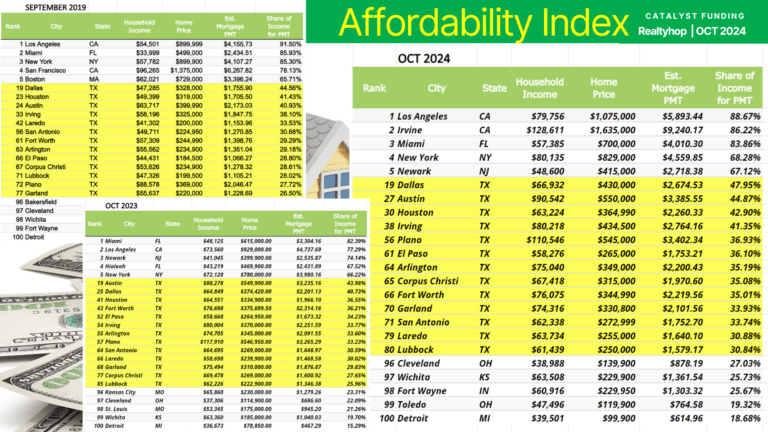
Affordability Index and Investment Opportunities
Despite positive signs, affordability remains a pressing concern in many urban areas. However, if you’re ready to explore vibrant cities with a lower cost of living, consider the charm of Dallas, Houston, and Austin—where your dollar goes further compared to places like Los Angeles and Miami! Plus, San Antonio has emerged as a hidden gem, offering incredible buying opportunities and making it an ideal spot for affordable living. The RealtyHop Housing Affordability Index highlights these opportunities and analyzes projected median household income, median listing prices, local property taxes, and mortgage expenses. This analysis provides a comprehensive overview of potential investment returns across the nation’s most populous cities, underscoring the importance of strategic real estate lending approaches.
Article References
Active Listings Continue Upward Trend (Realtor.com)
Current Outstanding Mortgage Rates (Calculated Risk)
Homeowners’ Equity at Historic Highs (Realtor.com)
Affordability Index and Investment Opportunities (Realty Hop)

How Much Down Payment Do You Need for a Texas Investment Property?
A conventional loan on a Texas single-family rental requires at least 15% down, but closing costs and six months of reserves push the real cash total on a $300,000 Houston rental to about $68,600. Here’s what lenders check, where non-QM loans fill the gaps, and five ways investors get into deals with less money down, including 100% financing on qualifying fix-to-rent deals.

How to Buy an Investment Property in Texas With Less Risk: A 2026 Investor’s Guide
Most Texas investors who pass on a good deal are stuck on one of six fears: not enough capital, high rates, a soft market, overpaying, a rehab that runs over, or a slow exit. This guide covers what drives each one, what Q3 2026 data shows, and how 100% loan-to-cost financing can cover the purchase and renovation on qualifying deals.

Austin’s $6.5 Billion Capital Wave: What the Tech Rebound Means for Central Texas Real Estate Investors
Austin companies have raised about $6.5 billion so far in 2026, more than double last year’s pace, and this time the money is going into semiconductors and hard tech rather than remote-friendly software. Here’s what that shift, plus July’s rebound in sales volume, means for flip, rental, and BRRRR investors across Central Texas.

What August 2026 Data Tells Texas Real Estate Investors About Q4: Rates, Jobs, and the Reset Investors Need to Make
Here’s what the August 2026 data actually means for Houston, Austin, Dallas, and San Antonio, plus the five-point strategic reset worth making before Q4.