

832.699.6960 Sales

832.648.3626 Support

A Texas Investor’s Guide to Evaluating Deals with Confidence

A Texas Investor’s Guide to Evaluating Deals with Confidence

Why investors guess, and why they shouldn’t

One of the most common challenges new real estate investors face is uncertainty about which properties to pursue. Without a defined framework, every listing and off-market deal from a wholesaler look like a potential opportunity, and the lack of clear comparison points makes it difficult to identify which deals are genuinely viable.

The investors who consistently succeed in Texas markets do not rely on intuition. They operate within a defined set of criteria, evaluate every opportunity through a repeatable mathematical framework, and make offers based on calculated outcomes rather than estimated potential.

This article outlines that framework: how to establish your investment boundaries through prequalification, how to define a clear buying criteria, and how to analyze the math to evaluate any property with mathematical confidence.

If you are looking at everything, you are evaluating nothing.

The first step toward confident investing is defining the specific kind of deal you are looking for, and the financial parameters that make it work.

Step 1: Start with prequalification

investors guide to smart investing in Texas

Before evaluating any specific property, every real estate investor should begin with one foundational step: getting prequalified with a lender.

Prequalification establishes the financial boundaries within which you can confidently operate, and removes a significant source of uncertainty from every subsequent decision. In a competitive market, knowing exactly what you can afford enables you to make informed decisions, negotiate from a position of strength, and evaluate potential investments with greater clarity and discipline.

Prequalification answers the most important questions at the outset:

  • What loan amount can you qualify for?
  • What loan-to-value (LTV) and loan-to-cost (LTC) terms apply to your situation?
  • What financing structures are available for the strategies you are pursuing: fix-to-flip, fix-to-rent, DSCR, or 100% loan-to-cost on qualifying deals?
  • What is your realistic cash-to-close range across different deal sizes?
  • How will these terms back into establishment profit, cash flow, cash o cash return and other important metrics.

With these parameters defined, every property you subsequently evaluate can be measured against a known financing structure. You stop wondering whether a particular deal is feasible and start knowing definitively whether it fits within your operating range.

At Catalyst Funding, prequalification is free, requires minimal time, can be done with a soft credit pull (meaning no inquiry or impact to credit rating) and produces actionable terms you can use across your search. Investors at every experience level (including those preparing for a first acquisition) benefit from completing this step before they begin reviewing properties.

Step 2: Define your buying criteria

After prequalification, the next step is defining the specific criteria of the properties you will pursue. Experienced investors refer to this as their “buy box” – a clearly defined set of parameters that establishes what qualifies as a potential acquisition and what does not.

A well-defined buy box typically includes:

  • Target geographic area (specific neighborhoods or submarkets such as Houston, Dallas, San Antonio, Austin, Beaumont, or others)
  • Property size range (bedrooms, bathrooms, square footage)
  • Price point range, aligned to your prequalification limits
  • Renovation finish level appropriate for the target neighborhood
  • Investment strategy alignment (fix-to-flip, fix-to-rent, or BRRRR)

Defining these parameters serves a critical function: it gives you a baseline against which to measure every opportunity. After reviewing ten comparable properties, the differences quickly become apparent. A genuinely strong deal stands out clearly because you have a meaningful basis for comparison.

Investors who define a clear buying box evaluate ten similar properties and immediately recognize a good deal. Investors who evaluate every property type in every market lack a clear basis for comparison and often miss valuable opportunities.

Why this approach prevents costly mistakes

Without defined buying criteria, investors often default to evaluating each property in isolation. Apparently, this approach makes it nearly impossible to determine whether a given price represents value or simply matches the asking price. The absence of comparison points is the primary reason investors hesitate, overpay, or pass on legitimate opportunities.

Staying within a defined box (even a relatively broad one) creates the comparison framework that informs confident decision-making. As you accumulate experience within your chosen criteria, your ability to identify exceptional opportunities improves continuously.

Step 3: For quick & dirty evaluations, apply the percentage of ARV rule

Once you define your investment box, you can evaluate each property using a single, widely adopted mathematical framework: the After-Repair-Rule (ARV).

The percentage of ARV rule states that the combined cost of your purchase price plus your renovation budget should not exceed a certain percent of the property’s after-repair value: that is, what the property will be worth once the planned renovations are complete.

The appropriate percentage depends on the ARV, needed repairs, neighborhood profile, industry standards, days on market, exit strategy, and more.

For example, fix to rent investors can and should pay more for properties than fix and flippers if the cash flows and cash on cash returns are strong. They might pay 80%, 85% or more of a properties after repairs value if the cash flow and return on investment is right.

Additionally, really larger rehabs take more time and have more risk. Therefore, you should pay a lower percentage of the ARV for those properties. Maybe only 72.5% or 70% is right.  If it is a light rehab in a fantastic market with very low days on market, you can pay up for a rental or a flip! Some flippers will pay well above 75% for those deals and do really well because they are fast and safer.

Expressed as a formula: 

Core Formula
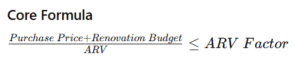
ARV core formula

Where:

  • ARV = After Repair Value
  • Purchase Price = Acquisition cost
  • Renovation Budget = Estimated rehab costs
  • ARV Factor = Maximum percentage of ARV you’re willing to invest (expressed as a decimal)

Solve for Maximum Purchase Price

Most investors use the formula to determine the highest price they should pay:

Maximum Purchase Price=(ARV×ARV Factor)Renovation Budget

Putting the framework together

The three steps outlined above: prequalification, defined buying criteria, and the ARV rule form a complete framework for evaluating real estate investment opportunities with confidence:

Prequalification establishes the financial range within which you can operate, removing uncertainty about feasibility.

A defined buying box narrows your focus to a manageable subset of opportunities where you can develop genuine market expertise and identify exceptional deals through comparison.

The ARV rule provides the mathematical standard against which every opportunity is measured, producing repeatable, defensible decisions.

Together, these three elements transform real estate investing from intuition-based decision-making into a structured, repeatable process. Investors who apply the framework consistently develop the ability to evaluate a property quickly, calculate a justified offer price, and act with confidence because they truly know whether they have a deal.

Tools that support disciplined deal evaluation

To support investors in applying this framework efficiently, Catalyst Funding offers two complementary resources:

Free prequalification

Available at catalystfdg.com, prequalification establishes your financing parameters and gives you a clear, written basis for evaluating opportunities within your range. The process is straightforward, and our loan officers work with investors at every experience level: from first-time buyers to portfolio operators.

The Catalyst Deal Analyzer

Deal Analyzer allows you to input the purchase price, renovation budget, and ARV of any property and instantly calculate whether the deal meets the 75% rule, along with projected cash out of pocket, profit (for flips), cash flow (for rentals), and equity capture. The tool also lets you adjust your inputs in real time to see how changes in renovation budget, ARV, or financing structure affect your outcome. It is free to use and requires no account.

Used together, prequalification and the Deal Analyzer provide a complete pre-acquisition workflow: define your financing range, identify a property within your criteria, run the numbers, and confirm the deal before making an offer.

Catalyst Funding can provide the perfect financial solution for your investment needs.

Whether you’re investing in Houston, Dallas, San Antonio, Austin, or any other area in Texas, we’ve got you covered!

How Catalyst supports investors at every stage of growth

Catalyst Funding has been supporting Texas real estate investors across Houston, Dallas, San Antonio, Austin, and Beaumont since 2014. We structure our rehab financing around the entire investment lifecycle: from hard money origination to take-out loan closing, because investors experience the deal as one continuous transaction.

We begin working on your take-out loan during the entire rehab, so that when your project is complete, the transition to long-term financing is immediate rather than delayed. That structure consistently saves our investors one to two months of high-interest carrying costs – money that stays in their return rather than in financing overhead.

Our team includes experienced investors who understand what is at stake at every stage of the deal cycle. We offer pre-approval for investors at every experience level, and our free Deal Analyzer at analyzer.catalystfunding.com allows you to model your full financing structure — including projected carrying costs, cash flow at stabilization, and equity capture — before you commit to any acquisition.

For deal analysis, our free Deal Analyzer allows you to model your flip or rental numbers: cash out of pocket, projected profit, cash flow, equity capture before you commit to any acquisition. Running your numbers through the analyzer on every deal is one of the simplest ways to build the analytical discipline that compounds into better long-term results. 

Build the foundation. Scale with confidence.

Whether you are working on your first investment property or scaling an established operation, Catalyst is here to support your growth with fast, reliable capital and the expertise to help you make better decisions at every stage.

Get Started with Catalyst Funding - Today!

If you want help structuring a deal so the refinance appraisal doesn’t derail your exit, the Catalyst team works through these scenarios with investors every day.

Reach out to Catalyst Funding and start investing with confidence: